

The 4-Hour Work Week Review: What Still Holds Up, and What to Skip
Read it, and skip about a third. The first third is the reason to bother; AI has overtaken the rest.
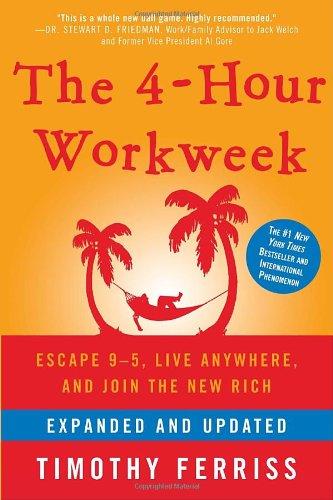
Cover via Open Library
The verdict
- Writing
- 4.0
- Narration
- not heard
- Author
- Timothy Ferriss
- Length
- 448 pages
- Publisher
- Harmony
- Category
- Business & Money
Read it, and skip about a third. The expanded edition still earns its hours because it gives you permission to question whether the default working week is the only option. The tactics are museum pieces and AI has overtaken several outright. I read it more than once and it changed what I do for a living.
What is it actually arguing?
The pitch is narrower than the cover suggests, and Ferriss says so himself fairly early. He is not promising you a four-hour week. He is arguing that the standard deal, forty-odd years of full-time work and then retirement, is a default nobody chose on purpose, and that you can take pieces of that retirement now instead of banking all of it for later.
The method runs in four steps he calls DEAL, and they are unequal in value.
Define is where you work out what you actually want and what it costs. The two exercises here are the best things in the book. Dreamlining makes you write down the life you say you want as specific line items with monthly prices attached, and the number that comes out is almost always smaller and nearer than "get rich" had led you to assume. Fear-setting makes you write down the worst realistic outcome of the change you are avoiding, then how you would undo it, then what it is costing you to keep not deciding. Both take an afternoon. Both survive everything else in the book going out of date.
There is a definition underneath all of this that people miss, and it is the load-bearing one. Ferriss separates being rich from being free by asking what an hour of your life buys rather than what a year of it pays. Fifty thousand earned across ten hours a week is a different life from a hundred thousand earned across eighty, and only one of the two numbers appears on a payslip. Once you have accepted that framing, most of the rest of the book follows from it, and if you reject it the book has nothing for you.
Eliminate is time. The 80/20 idea, which Ferriss borrows rather than invents, says a small share of what you do produces most of what you get, so the useful move is subtraction rather than efficiency. The low-information diet chapter tells you to stop grazing on news and feeds. Written in 2007, aimed at RSS and cable news, and it reads better now than it did then.
Automate is the muse: build or source a product that sells without you, test it cheaply, then hand the running of it to other people. This is the part that has aged worst, and I will come back to it.
Liberate is getting out from under a fixed desk. There is a remote-work proposal you can adapt, a chapter on quitting, and the mini-retirement idea, which is the argument for taking time off in chunks during your working life rather than saving it all for the end.
Which parts are still worth your time?
Define and Eliminate. If you read only the first third and the exercises inside it, you have had most of what this book can give you.
Dreamlining is the reason I would still hand it to someone. Writing your target life down as monthly numbers turns a vague ache into arithmetic, and arithmetic can be solved. That single exercise is why the book landed for me, and it is why the rest of the argument became thinkable rather than a fantasy about beaches.
Fear-setting is the other one. The exercise treats putting off a big change as a refusal to look at it rather than a weighing of it. It has you write the worst case out in plain sentences, and its third question asks what standing still is costing you.
The elimination material holds up because the underlying observation holds up: being busy and being effective are different states, and most working days are optimised for the first. Ferriss is blunter about applying it to an ordinary Tuesday than most business writers manage.
And the underlying question has held up entirely. Is the default the only option? For me the answer turned out to be no. I stopped working to make money for other people and started my own thing, and this book is a real part of why. I have read everything Ferriss has written since, which is either a recommendation or a warning depending on what you make of him.
Which parts should you skip?
The tooling, and most of Automate.
Some of it is simply old, and you can read past it. Google AdWords, which the book treats as the way to test an idea, was renamed Google Ads in 2018. There is a section on managing your BlackBerry, and BlackBerry ended service for its legacy devices in 2022. Treat every named service, price and platform tactic as a historical example rather than an instruction.
One piece needs more than a shrug. The five-dollars-an-hour overseas assistant framing is still repeated in the publisher's own description, and it should be read as a 2009 claim, not a rate. Any real decision about outsourcing now needs current work on wages, privacy, employment law and quality control, none of which the book does or claims to. The chapters are also breezier about the people on the other end of that arrangement than sits comfortably today.
The New Rich mistakes list at the back is fine and skimmable. The bonus section is worth ten minutes with the contents page rather than a straight read.
Has AI made the plan easier, or pointless?
Both, and this is the part no edition of this book has caught up with.
The muse chapters assume the hard part is finding and testing a product. Getting from an idea to something you could actually sell used to take months and money, so most of Automate is about compressing that. It worked, and it is why the book produced a generation of small online businesses.
That problem is now solved to the point of being boring. A plan and a working first version are an afternoon. You can have the positioning, the copy, the landing page and a testable product before dinner, for roughly nothing.
Which would be wonderful, except everyone else can do it too. The same tools that removed the barrier removed it for all of us at once, so the bottleneck moved rather than disappearing. Finding the product is no longer where the difficulty lives. Being distinguishable from the several thousand people who found the same product on the same afternoon is, and the book has essentially nothing to say about that, because in 2007 it was not the constraint. Its answer to "how do I stand out" is "test more variations", which is now the thing everyone is doing to everyone.
So, read Automate as history. The mechanism it describes worked, and the arbitrage it depended on is gone.
And has the world already done the hard part?
Most of it, yes, and not in the way anyone hoped.
When this was written, leaving a salaried job to work independently from somewhere else was a genuine leap, and a large share of the book's energy goes into convincing you it is survivable at all. That argument has been won without Ferriss. Millions of people worked from home for years and found out they could do it.
They found out something less comfortable at the same time. Their employers needed them less than either side had assumed. Add the current round of roles being handed to software and the position is fairly plain, and it is the opposite of the one the book was written into. In 2007 the risky move was leaving. Now the risky move might be staying and hoping.
One idea got quietly stronger while nobody was looking. Mini-retirements, the argument for taking real time off in chunks during your working life instead of banking all of it for the end, read in 2007 as a luxury for people with unusual jobs. The infrastructure for it now exists everywhere: the tools are normal, the employer objection has been tested to destruction, and a large number of people have already proved the work gets done. It is the one part of Liberate that the last few years made easier rather than obsolete, and it is worth reading properly even if you skip the chapters either side of it.
So, the escape is a shorter jump than it was, because the landing area is normal now. It is also a more urgent one, because the thing you would be escaping from stopped being the safe option.
That is the honest verdict. We have moved past this book and we need it more than ever. Its tactics are obsolete and a few are actively misleading. Its central question has never been more pressing, precisely because the default stopped being safe. I would like Ferriss to write the version that starts from where we are now. If he does not get to it, that might be a job for me.
Should you get the audiobook instead?
Get the book, and there is a specific trap to avoid if you want the audio anyway.
Much of the expanded edition is not prose. It is apparatus: templates you are meant to copy, a remote-work proposal, case studies you flip back to, worksheets and an index. The UK publisher's own audio listing warns that the audiobook refers to accompanying material not included with it. Unabridged means the words were not cut. It does not mean the pages work in your ears, and here they do not. If you want the exercises, you want the book in your hands.
The trap: there are two unabridged Ray Porter recordings and they are different books. The 2009 expanded edition runs 13 hours 1 minute. The 2007 original runs about 8 hours 19 minutes. Amazon's own audiobook link from the 448-page print page points at the shorter 2007 one, so it is easy to buy four and a half hours less book than you meant to. Check the runtime before you spend a credit. The correct one is linked at the end of this review.
I have not listened to either, so there is no narration score on this review.
Who should read it, and who should skip it entirely?
Read it if you have never once seriously questioned whether the standard working week is the only arrangement on offer. That is the reader this book can still reach, and it reaches them hard. Read it if you are in the first year of thinking about working for yourself and you need the arithmetic of what your life actually costs. Read it if you are stuck on a decision you keep not making, and read the fear-setting chapter first.
Skip it if you already run your own thing. Most of it will be obvious and the dead tooling will irritate you. Skip it if you want a current playbook for building an online business, because it is not one and using it as one will cost you money. Skip it if you need the number on the cover to be literal.
If it is the cultural argument you want rather than the buying decision, Cal Newport's New Yorker revisitation is the better hour.
Questions readers ask
Is The 4-Hour Work Week outdated? Partly. The tools, prices and platforms in it are from 2009 and should be read as examples. The first third, defining what you want and cutting what does not matter, has not dated at all, and the low-information diet chapter has aged into something more useful than it was.
Is it still worth reading? Yes, if you are still inside the default and have not questioned it. The argument for leaving is more pressing now than when it was written, even though the specific methods for doing it have moved on.
What is Tim Ferriss' 80/20 rule? It is the Pareto principle applied to a working day: a small share of your effort produces most of your results, so the useful move is cutting the rest rather than doing all of it faster. Ferriss borrowed the idea; what he added was applying it bluntly to ordinary work.
What are the main criticisms? That the four-hour figure is a marketing number rather than a description, that the muse chapters assume an internet that no longer exists, and that the outsourcing sections treat cheap overseas labour casually. All three are fair. None of them cancel the first third.
Is it on Audible, and is the audiobook any good? There is an unabridged Ray Porter recording of the expanded edition, 13 hours 1 minute. I have not heard it, so I am not scoring it. I would still point you at print, because the templates, worksheets and index do not survive the format.
Which edition should I buy? The 2009 Expanded and Updated, 448 pages. The 2007 original is a shorter book without the case studies, templates or bonus section.
The short version
Four out of five for the writing, and that number is doing real work rather than splitting a difference. A third of this book is a period piece and I would tell you to skim it. The rest asked me a question I had been avoiding, and I answered it by leaving. Eighteen years on, the tactics belong to an internet that is gone, and the question is one more people should be asking than at any point since it was published.
We have moved past this book and we need it more than ever.
- Full Review
- Business & Money
- Thought-provoking
- Adventurous
Read This Next
All reviews
Emergency Neil Strauss Review: The Book That Changed How I Live
Neil Strauss, narrated by Neil Strauss
- Writing
- 4.75
- Narration
- 4.0

Everyone Loves You When You're Dead Book Review: No Audiobook, and Why
Neil Strauss
- Writing
- 4.25
- Narration
- none exists
Neil Strauss in Audio: Two of the Big Ones Are Abridged

The Game Neil Strauss Audiobook Review: What the Cut Costs
Neil Strauss, narrated by Neil Strauss
- Writing
- 4.0
- Narration
- 3.5