

Great Big Beautiful Life Review: Margaret Is the Reason
Two books stapled together, and the historical half is the better one. Whether that suits you decides everything.
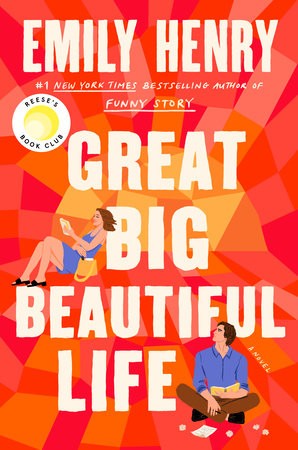
Cover via Open Library
The verdict
- Writing
- 4.0
- Narration
- 4.5
- Author
- Emily Henry
- Narrator
- Julia Whelan
- Runtime
- 12 hr 3 min
- Publisher
- Berkley
- Category
- Literary & Contemporary
Listen to this one if the pitch that lands for you is Emily Henry crossed with The Seven Husbands of Evelyn Hugo. Read something else if you came for banter and a romance that owns the center of the book. It is two books stapled together, and the historical half is the better one. I scored the writing 4.0 and Julia Whelan's narration 4.5.
The reactions to this book are split in a way that looks like disagreement and is really a sorting problem. Which half you weight decides whether you land at a five or a two. So, the useful thing this page can do is tell you which reader you are before you spend twelve hours finding out.
What is it actually about?
Alice Scott is a celebrity journalist who lands what could be the break of her career: a month on a small island off the Georgia coast with Margaret Ives, an heiress and former tabloid fixture who dropped out of public life decades ago and has never told her story.
The catch is that Alice is not the only one there. She is competing with Hayden Anderson, a Pulitzer-winning biographer with none of her sunniness. Margaret is telling each of them a version of her life, separately, and neither writer is allowed to compare notes.
Why the versions differ is the engine of the whole thing, so that is as far as I will go. There are no spoilers anywhere on this page.
Is the historical half really that much better?
Yes, and it is not close.
Margaret's story runs from gold rush money through the early machinery of Hollywood fame. Henry writes it with a control and a sense of accumulated cost I had not seen from her before: a family that becomes famous, then notorious, then a cautionary tale, told by the last woman left who was actually there. It is good historical fiction by any standard, not just by the standards of a romance novel with a historical subplot.
It also does something romance rarely makes room for. It lets a woman in her eighties be the most interesting person in the book, and it never once treats her as a device for teaching the young people a lesson.
The contemporary half is pleasant and competently built. The grumpy-sunshine push and pull works. Alice is likeable and the rivalry has real stakes. But next to Margaret it reads like the frame around the painting, and I noticed I was hurrying through Alice's chapters to get back to the island interviews. The tonal seams do show, and I would argue that is less a clash between the two halves than the plain fact that one of them is stronger.
That is a 4.0 from me. The ceiling here is high enough that the weaker half still clears most of what it is competing with.
Is the audiobook worth twelve hours?
This is where the book got better for me.
The recording is just over twelve hours, unabridged, from Penguin Audio, and Julia Whelan reads the whole thing on her own. There is no split cast, which surprised me, because the book asks one performer to hold two registers roughly a century apart.
Whelan carries Margaret completely. I scored the narration 4.5, and that is the second review running where the narration comes in above the writing, which is worth saying plainly rather than burying: the two scores exist so you can see which half you would be paying for.
I want to be careful about what that does and does not mean. She is reading both strands, so this is not a case of one narrator outshining another. It is that the material she has most to work with is the material she is best in.
If you want a sense of her range before committing a credit, her verifiable record is easy to check: she won the 2019 Audie for Best Female Narrator for Educated, and AudioFile named her a Golden Voice in 2020. This recording won an AudioFile Earphones Award in 2025 and was a finalist for the 2026 Audie in Romance, though it did not win that one.
Should you read it or listen to it?
Listen.
Unusually for a book with a dual structure, there is no edition trap to warn you about. There is one English recording, and the CD, the UK download and the Reese's Book Club version are all the same performance in different packaging. Nothing you buy has more or less of the book in it.
The print edition has one small advantage worth knowing. This is a novel that moves between two timelines, and on the page the switch is visible before you read a word. In audio it arrives in the voice. If you tend to lose track when a book switches timelines, the print headings are the easier way in.
Against that, the interview sections are the best thing here, and they are written to be heard. Margaret is talking into a recorder for most of the book. Whelan is doing, out loud, the thing the text is describing.
Is this a romance or is it historical fiction?
Both, and the argument about which one it "really" is has swallowed most of the conversation around this book. The practical answer is more useful than the argument.
It is published, shelved and marketed as romance. Berkley is a romance imprint, it was a Reese's Book Club pick in May 2025, and it won the 2025 Goodreads Choice Award for Readers' Favorite Romance. The audiobook was a finalist for the Audie in the Romance category. Every official classification files it as a romance, and the contemporary strand does deliver a romance arc, start to finish.
What makes people argue is proportion. A substantial share of the book is Margaret's twentieth-century family saga, and that material is not romance in any useful sense. It is closer to a fictional oral history. If your working definition of a romance novel is that the love story is the load-bearing wall, this one will feel like the wall is somewhere else.
So, the honest shelving answer is: it is a romance that spends a lot of its time being something else, and whether that reads as ambition or as a bait and switch depends entirely on which of the two you would rather be reading.
Should this be your first Emily Henry?
No, and that is not a knock on it.
Start with Beach Read or Funny Story if you have not read her before. Both are the thing she is known for, both keep the romance at the center, and both will tell you quickly whether her voice works for you. This book asks you to already be interested in what happens when a writer known for one thing reaches for another, and that is a more interesting question if you have read the one thing.
There is also a practical reason. Two of her books are the ones this review keeps sending people toward, and if you bounce off this one without having read those, you may conclude the author is not for you when what actually happened is that you started with the outlier.
If you have read several of hers already, the calculation flips. This is the one where she is visibly trying something harder, and the ambition is the appeal.
Is it a good book club book?
Unusually good, and better than most Reese's picks I have read.
The reason is the structure people keep arguing about. A book where half the readers came away satisfied and half felt misled is a book with something to actually discuss, and the disagreement is not a matter of taste alone: it is a real question about what a novel owes the expectations it was sold on. That is a better prompt than most publisher-supplied discussion guides manage.
Margaret's half gives a group the other thing it needs, which is material with weight to it. Fame, family money, what a woman of that generation was permitted, and what it costs to be the only person left who remembers. Those go somewhere in a conversation.
One practical warning. The explicit content is genuinely explicit, so if your group has been burned by that before, flag it when you pick rather than after.
What should you know before you start?
This is an adult romance and the sexual content is explicit and on the page. It is not a closed-door book.
I am saying that plainly because it is the single most-asked question about this title, and readers arrive at it from two directions. Some want to know whether it is explicit enough, given it is sold as a romance. Others want to know whether it is clean. It is the former, clearly, and if that is a problem for you it is better to know now.
Beyond that, the topics a reader might want flagged: grief and bereavement including a parent's death; a car accident; pregnancy and miscarriage; illness and medical material; anxiety, panic and institutionalization; emotional abuse, coercion and gaslighting; infidelity; stalking and invasion of privacy; body image and eating disorders; alcohol use; and bullying, classism and sexism.
Those are topics, not scenes, and I have not told you where any of them falls in the story. Neither Berkley nor Emily Henry publishes an official content note for this book, so any list you find, this one included, is a reader's reading rather than a publisher's label.
Who will love this, and who should skip it?
You will probably land near five stars if you read for character and voice, if the sweep of a life told backward appeals to you more than a meet-cute does, or if Evelyn Hugo is the comparison that made you pick this up. Margaret Ives is worth the admission price by herself.
Skip it, or at least reset your expectations, if you came to Emily Henry for banter, heat, and a romance that owns the center of the book. That is a completely reasonable thing to want from this author, and this is not the book that delivers it. Beach Read and Funny Story are.
I do not think the low-star reviews are wrong about what they experienced. I think they ordered something else and got this. Both of those things can be true, and knowing which order you are placing is most of the decision.
Common questions
Is Great Big Beautiful Life a standalone? Yes. Emily Henry's own FAQ says she has no plans to write sequels for any of her books, while leaving the door open to revisiting characters if a future story warranted it. Nothing has been announced for this one.
Is there a movie coming? Not this book, and not yet. As of August 2026 there is no announced adaptation of Great Big Beautiful Life: no studio, no cast, no date. Henry said in an interview in August 2025 that she would like to write the screenplay one day, which is a hope rather than a deal.
Then where did the movie idea come from? Because five of her other books are in motion. People We Meet on Vacation came out as a Netflix film in January 2026. Beach Read is in development at 20th Century Studios with Yulin Kuang writing and directing, and Book Lovers is in development at Tango Entertainment. Netflix announced Funny Story and Happy Place in January 2026, with Henry writing both adaptations herself.
Who narrates the audiobook, and is it a full cast? Julia Whelan, alone. The publisher credits it "Read by Julia Whelan", and there is no second performer despite the two timelines. It runs just over twelve hours, unabridged.
Is there a People We Meet on Vacation Easter egg in it? Readers discuss one, and I am not going to confirm it. There is a secondhand report that Henry mentioned glimpses of that book's couple turning up here, but I could not find it stated on her site or by her publisher, so I will not point at a specific moment and tell you it is there. What I can tell you is the part that matters: no reading order is required, and you lose nothing by starting here.
How long does it take? The hardcover is 432 pages and the audiobook is just over twelve hours. Do not convert one to the other; the large-print and library editions run to 544 and 636 pages respectively because they are separately typeset, not because they contain more book.
Are the special editions different books? No. The Target exclusive adds a letter from Emily Henry about writing the book, which is front matter rather than story, and the Barnes & Noble, Walmart and Indigo editions differ in cover art and presentation only. The 2026 trade paperback is the same text as the hardcover.
Where I come out
I went in expecting an Emily Henry novel and got a historical epic with an Emily Henry novel wrapped around it. That was a happy accident for me and it will be an irritation for somebody else, and I do not think either of us is misreading the book.
What I did not expect was that the best thing on my shelf this month would be an eighty-year-old woman talking into a tape recorder about a family that destroyed itself in public. Margaret Ives is the reason to read this. Put Whelan in your ears and let her tell it to you.
- Full Review
- Literary & Contemporary
- Julia Whelan
Read This Next
All reviews
Emergency Neil Strauss Review: The Book That Changed How I Live
Neil Strauss, narrated by Neil Strauss
- Writing
- 4.75
- Narration
- 4.0

Everyone Loves You When You're Dead Book Review: No Audiobook, and Why
Neil Strauss
- Writing
- 4.25
- Narration
- none exists
Neil Strauss in Audio: Two of the Big Ones Are Abridged

The Game Neil Strauss Audiobook Review: What the Cut Costs
Neil Strauss, narrated by Neil Strauss
- Writing
- 4.0
- Narration
- 3.5