
Project Hail Mary Audiobook Review: Why Ray Porter's Narration Is the One to Hear
Listen to this one. Ray Porter plays the alien language and the fear under the jokes, and the book still gives you what the film cannot: a man thinking.
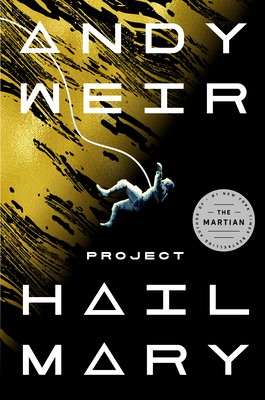
Cover via Open Library
The verdict
- Writing
- 4.0
- Narration
- 5.0
- Author
- Andy Weir
- Narrator
- Ray Porter
- Runtime
- 16 hr 10 min
- Publisher
- Ballantine Books
- Category
- Fantasy & Sci-Fi
Listen to this one. Ray Porter's narration is the best way to meet Project Hail Mary, not a convenient alternative to the page. I read the book and heard all sixteen hours, and the audio does two things print cannot: it plays the alien language, and it puts the fear under the jokes. Read it either way, though, even if you have seen the film.
What is it actually about?
The premise fits on a napkin. A man wakes on a spacecraft with no memory of who he is or why he is there, and the two people in the beds beside him are dead. What he does have is a working knowledge of science and a compulsive need to solve things, and the engine of the book is watching him reason from total ignorance to a functioning understanding of his own mission.
It is the same pleasure The Martian ran on, with higher stakes and a stranger, warmer heart in the middle of it.
If you have read The Martian you know the rhythm. A problem appears, it looks unsolvable, and then somebody works it. The satisfaction is not the solution, it is the reasoning: you watch a competent person take an impossible situation apart into things they can measure. Weir is very good at making that legible without making it condescending, and the book keeps raising the stakes just as you get comfortable.
What is different here is that the reasoning eventually stops being solitary. That is as much as I will say.
It gets filed under hard science fiction, and the physics is the delivery mechanism rather than the payload. What the book is about is two minds meeting across an impossible gap and deciding to help each other. The science is how they do it. The friendship is why you will finish at two in the morning and then sit there for a minute.
What does the narration do that the page cannot?
The alien speech. In print, the language of the non-human character appears as runs of musical-note glyphs while it is still unintelligible, and switches to italicised English once the viewpoint character has worked it out. Your eye registers the difference instantly. What your brain does with a line of note symbols, though, is not much. It is a clever typographic signal for something you cannot hear.
The audio actually plays it. You hear the notes and chords, and later Ray Porter speaks the English on top of them with the notes mixed lower underneath. Andy Weir has described this himself: the recording starts with the notes, then adds Porter speaking the words over them.
That is not a better performance of the same thing. It is a layer the printed page cannot literally play. The character stops being a device on the page and becomes someone you can hear thinking.
The fear under the jokes. This one is quieter and I would put it almost as high. So much of this book is a man talking himself through panic. Porter plays the gap between the wisecracking narrator and the frightened man underneath him, and you catch the tremor under the joke in a way flat text does not force you to notice. On the page you can read the joke as a joke. In your ears you cannot.
Is it worth the sixteen hours?
Sixteen hours and ten minutes, unabridged, and yes.
The recording won the 2022 Audie for Audiobook of the Year and the 2022 Audie for Science Fiction, both outright wins, per the Audio Publishers Association. It also holds an AudioFile Earphones Award. In April 2026 Audible put Porter in its Narrator Hall of Fame, though that is recognition of a career rather than of this book.
Awards are evidence of an honour, not proof you will like something.
Which recording, and is there more than one?
There is one English recording: Ray Porter, Audible Studios, released 4 May 2021, the same day as the hardcover.
Some books have two unabridged recordings at different lengths, and a shop can link the wrong one. This book has one. What look like several audio editions of this book are packaging differences, a download versus a CD versus a library copy, not a second performance.
It is one narrator with sound design, not a full cast.
What do you give up by listening?
Less than you would think, but not nothing.
The print edition carries illustrations, including a spacecraft diagram. If you want them while you listen, keep a print or ebook copy within reach, though nothing in the science actually requires you to see a diagram. This is a novel, not an illustrated technical manual, and the drawings help you place things in space rather than carrying the argument.
The real cost is control. If you want to sit with the reasoning and follow it properly, the page lets you stop and read a paragraph four times until it clicks, and the audio does not. That is the one case where I would hand you the hardcover instead.
Audible has said approved changes were made to the text for the audio edition, so the two formats are not word for word identical. On everything that matters they are the same book.
Why the writing is a four and not a five
Because Weir's prose is a tool rather than an art object.
It is clear, fast and completely without ornament. Sentences carry information and get out of the way. There is no line in this book you will copy out and keep, and there is no page where you have to slow down to work out what a paragraph is doing.
That is the right call for this book, and it is still a four. The style is doing a job and doing it well. It is just not the thing you would praise the book for, in the way you might praise the ideas or the structure or the friendship at the centre. A five, for me, is a book where the writing itself is one of the reasons to read it. This is a book where the writing gets beautifully out of the way of everything else.
What surprised me, having done both
The humour lands differently out loud.
Weir's jokes are the most divisive thing about him, and hearing them performed pushes them further in whichever direction you already lean. If you find the voice charming, Porter makes it warmer. If you find it grating, he will not save it for you, and you will notice it more. That is a genuine difference between the formats.
I have seen the film. Is there anything left in the book?
Yes.
The adaptation is an Amazon MGM film directed by Phil Lord and Christopher Miller, written by Drew Goddard, with Ryan Gosling as Ryland Grace and Sandra Hüller as Eva Stratt. It ran 156 minutes and reached US cinemas on 20 March 2026. Goddard has said in an interview that it keeps the amnesia opening and the past-and-present structure of the novel.
It is a faithful film and in a few places it does things the book does not. But a camera and a book have different access to a person's head, and this is a book that lives almost entirely inside one. So, the question is not which is better. It is what each format can reach, and whether having had one you still want the other.
You do. Most of what makes the novel work is a man thinking, and thinking is the one thing a film has to show you from the outside.
I am not going to list what the film changed, because almost every change is a spoiler.
Is there anything to know before you start?
Not much.
The situation the book opens on involves two dead crew members, and the peril from there is the life-or-death kind rather than the atmospheric kind. There is swearing, of the sort a working engineer does under pressure. Nothing in it struck me as gratuitous, and there is no sexual content to speak of.
If you are asking on behalf of a younger reader, the only classification I can point you at belongs to the film, not the book: PG-13 in the United States, and 12A from the BBFC, which flags moderate threat, rude humour and drug references. Ratings boards do not classify novels, so treat that as a rough signal about the story rather than a verdict on the book, and note that the audiobook puts the swearing in your ears rather than on a page you can skim past.
Who should listen, and who should read instead
Listen if you want the full thing. That is my recommendation.
Listen especially if you have bounced off hard science fiction before, because the friendship at the centre carries you and Porter makes it carry harder.
Read instead if you want to work through the science properly, or if you are a re-reader who marks things up, or if you know the jokes will irritate you and you would rather take them at your own pace.
Listen if you drive, walk or do dishes and you have been looking for the audiobook that finally converts you.
Skip it if you want the science to be the point. It is the mechanism, not the subject, and if you came for the engineering you will find the middle of the book is really about somebody making a friend.
Questions readers ask
Should I read Project Hail Mary or listen to it? Listen. The audio plays the alien language as actual notes and chords with the English layered over them, which the page can only represent with note symbols. Read it instead if you want to stop and rework the science, because audio does not let you.
How long is the Project Hail Mary audiobook and who narrates it? Sixteen hours and ten minutes, unabridged, narrated by Ray Porter for Audible Studios and released in May 2021.
Is there more than one Project Hail Mary audiobook? One English recording. The other listings you may see are packaging differences, download versus CD versus library supply, rather than a second performance. It is also not a full-cast production.
Do I miss anything by listening instead of reading? The print edition has illustrations including a spacecraft diagram, but nothing in the science requires seeing them. What you give up is the ability to stop and reread a passage until it makes sense.
Which edition should I buy after seeing the film? Any of them. A movie tie-in paperback appeared in December 2025, and it is the same novel rather than a novelisation of the film. If you want the best version of the story, it is the audiobook.
The short version
Five out of five for the narration, which is the first time I have given that number and the least conflicted I expect to be about giving it. Four out of five for the writing, because Weir's prose is a tool rather than an art object. It is clear, fast and completely without ornament, which is exactly right for this book. It is just not the thing you would praise it for.
Read it. Listen to it if you can only do one.
- Full Review
- Fantasy & Sci-Fi
- Ray Porter
- Hopeful
- Funny
- Adventurous
Read This Next
All reviews
Emergency Neil Strauss Review: The Book That Changed How I Live
Neil Strauss, narrated by Neil Strauss
- Writing
- 4.75
- Narration
- 4.0

Everyone Loves You When You're Dead Book Review: No Audiobook, and Why
Neil Strauss
- Writing
- 4.25
- Narration
- none exists
Neil Strauss in Audio: Two of the Big Ones Are Abridged

The Game Neil Strauss Audiobook Review: What the Cut Costs
Neil Strauss, narrated by Neil Strauss
- Writing
- 4.0
- Narration
- 3.5